What Is MLOps?
A machine learning model that performs well in a notebook doesn't automatically perform well in production.
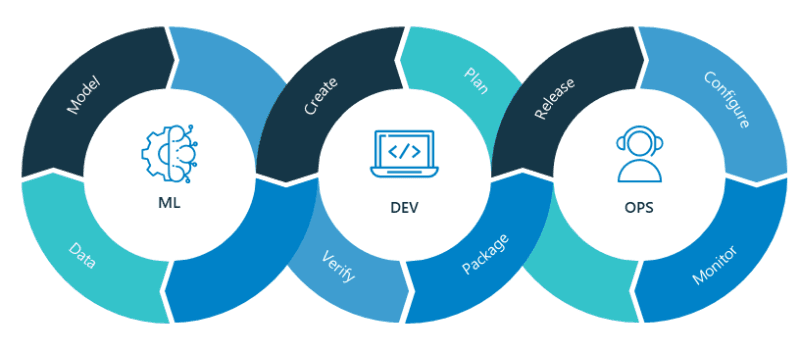
MLOps is the practice of connecting Data Science with software engineering and operations.
If Data Science focuses on building AI and machine learning models, MLOps makes sure those models can reliably operate in the real world, at scale, without falling apart the moment real traffic and real data hit them.
MLOps is the system that moves AI beyond experimentation and turns it into a production service people can actually depend on every day.
Understanding MLOps Through an Example
Think of an automotive manufacturing plant.
A data scientist designs a new engine. MLOps engineers build and maintain the production pipeline that turns that design into a reliable product, making sure every vehicle that comes off the line meets quality standards.
When the engine design changes, the production pipeline has to adapt quickly — without bringing the entire operation to a stop.
MLOps works the same way for machine learning systems. The model is the design. MLOps is the pipeline that keeps producing reliable results from it, version after version.
Model Monitoring and Continuous Improvement
One of the core responsibilities of MLOps is maintaining quality, reliability, and delivery speed over time — not just at the moment of deployment.
Machine learning models aren't systems you train once and forget. Real-world data keeps changing, and that drift can quietly degrade a model's performance long after it's shipped.
MLOps introduces monitoring and automated workflows that track model performance in production. When performance drops or data drift is detected, the system can trigger processes such as retraining the model on newer data.
That creates a continuous lifecycle:
Data
  ↓
Training
  ↓
Deployment
  ↓
Monitoring
  ↓
Retraining
  ↓
Deployment
A model in production is never really "done." It's a system that needs to keep being watched, evaluated, and updated.
Why MLOps Matters at Scale
The importance of MLOps becomes much more obvious once an organization is running hundreds or thousands of machine learning models at once.
Manually monitoring and maintaining every one of those models isn't practical — there aren't enough engineering hours in the day.
MLOps leans on automation, CI/CD pipelines, model registries, monitoring systems, and cloud infrastructure to handle repetitive operational work. That's what lets engineering and ML teams ship new capabilities faster while keeping existing models reliable, secure, and maintainable.
Without automation at this layer, growth in model count directly translates into growth in operational risk.
Conclusion
MLOps is one of the key foundations for making AI reliable and production-ready in 2026.
It acts as the bridge between machine learning research and real-world software systems. Without it, many AI models would stay limited to experiments and research environments — technically impressive, but never actually trustworthy in production.
With a strong MLOps architecture, organizations can deploy, monitor, update, and scale machine learning systems that serve large numbers of users reliably — not as a one-time launch, but as an ongoing engineering discipline.