Why MLOps Is the Missing Layer Between AI and Production
MLOps is the engineering discipline that connects machine learning development with reliable production systems. It helps teams deploy, monitor, retrain, and maintain AI models as real-world data and requirements continuously change.
Abdiwahid
5 min read
Why MLOps Is the Missing Layer Between AI and Production
Machine learning does not end when a model reaches a high accuracy score.
The real engineering challenge begins when that model needs to run reliably in production, serve thousands or millions of requests, process constantly changing data, and remain accurate over time.
This is where MLOps comes in.
MLOps combines the practices of machine learning, software engineering, DevOps, and infrastructure to create a reliable lifecycle for AI systems. Instead of treating a model as a one-time research artifact, MLOps treats it as a production system that must be deployed, monitored, tested, versioned, and continuously improved.
From Model to Production
A data scientist might train a model that performs extremely well on a controlled dataset. But production introduces problems that do not appear during experimentation.
Data changes.
User behavior changes.
Infrastructure fails.
Dependencies are updated.
Model performance can degrade.
A model that worked perfectly six months ago may produce significantly worse predictions today because the environment around it has changed.
MLOps provides the engineering infrastructure needed to detect and respond to these changes.
The goal is not simply to deploy a model once. The goal is to create a repeatable and reliable lifecycle for machine learning systems.
What Does an MLOps Pipeline Look Like?
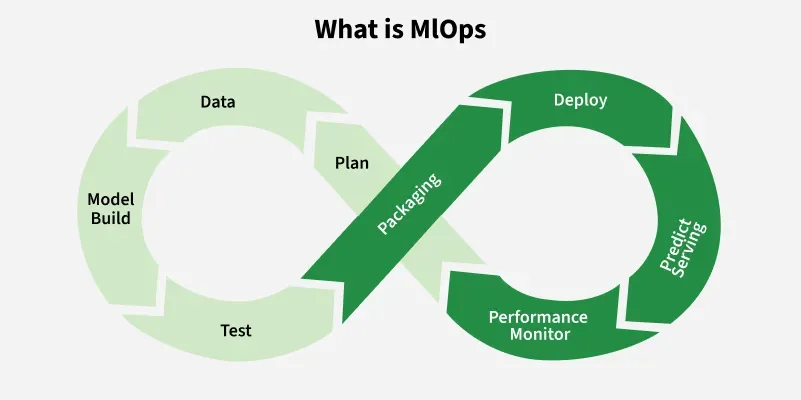
A production ML system usually involves several connected stages:
Data → Training → Evaluation → Versioning → Deployment → Monitoring → Retraining
Each stage needs to be reproducible and observable.
When new training data becomes available, the system should be able to run the appropriate pipeline, evaluate the resulting model, and determine whether it is safe to deploy.
This is similar to CI/CD in traditional software engineering, but machine learning introduces another dimension: the model itself is part of the software artifact.
That means teams need to track not only source code, but also datasets, model versions, experiments, configuration, and evaluation results.
Monitoring Is More Than Uptime
Traditional software monitoring often asks:
Is the service running?
Machine learning systems require a different set of questions.
Is the model still accurate?
Has the input data changed?

Written by
Abdiwahid
Senior Contributor