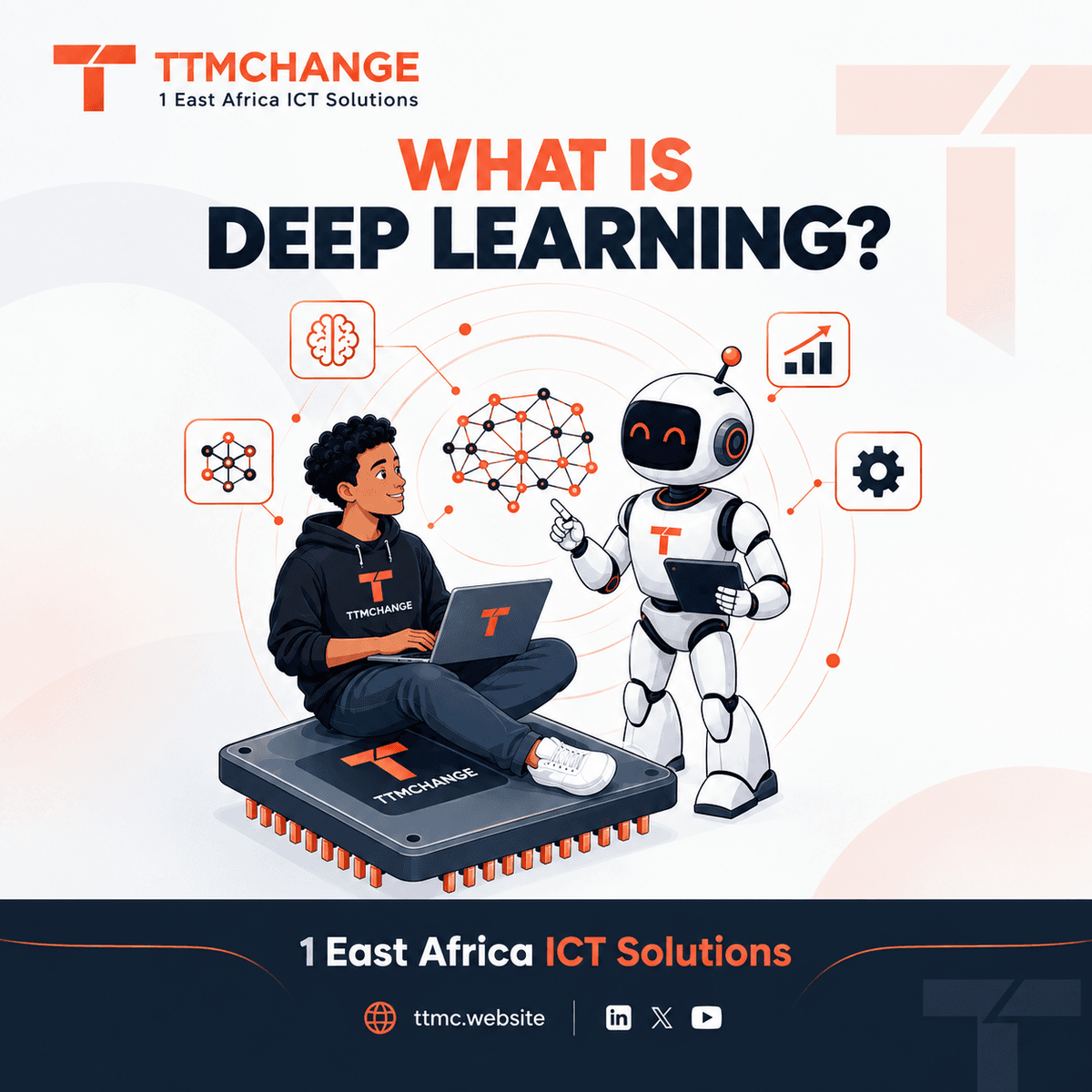
What Is Deep Learning?
Deep Learning is a major subfield of Artificial Intelligence that has enabled computers to perform tasks once considered possible only for humans — recognizing faces, understanding language, generating images, driving cars.
It's loosely inspired by how the human brain processes information. While traditional AI systems often rely on explicitly defined rules, Deep Learning uses artificial neural networks with multiple interconnected layers that learn patterns and representations directly from data, rather than being told what to look for in advance.
How Does Deep Learning Work?
Consider how a child learns to recognize a person.
At first, the child has no concept of what a face is. But after seeing their mother repeatedly, the brain gradually picks up patterns — facial features, voice, other characteristics — until recognition becomes automatic.
Deep Learning works in a similar way, though the mechanism underneath is mathematical, not biological.
A neural network contains multiple layers that progressively process input data:
Input
  ↓
Early layers — simple patterns
  ↓
Middle layers — combined features
  ↓
Deep layers — complex representations
  ↓
Output
Early layers might identify simple patterns — edges, colors, basic shapes. Deeper layers combine those patterns to recognize increasingly complex features, until the model produces a final output.
This layered learning process is where the term "Deep Learning" comes from — depth refers to the number of layers a network passes information through, not how sophisticated the model "feels."
Where Is Deep Learning Used?
Deep Learning powers a large share of the AI systems people interact with today.
Self-driving vehicles use it to detect pedestrians, vehicles, road signs, and other objects in their environment. Smartphone facial recognition systems use neural networks to analyze distinctive patterns in a face and determine whether it matches an enrolled identity.
Deep Learning is also widely used in:
- Natural Language Processing (NLP)
- Computer Vision
- Speech Recognition
- Recommendation Systems
- Generative AI
- Medical Image Analysis
- Autonomous Systems
Deep Learning vs. Traditional AI
One of the major differences between traditional AI approaches and Deep Learning is how they learn from data.
Traditional machine learning systems often depend heavily on human-designed features and rules — an engineer decides which characteristics of the data matter, and the model works from those. Deep Learning can automatically learn useful representations from large datasets through its neural network architecture, without that manual feature design step.
That capability comes at a cost, though. Deep Learning typically requires significant amounts of data, computational resources, and training time.
With sufficient high-quality data and an appropriate architecture, more training data can improve a model's ability to recognize complex patterns — but more data does not automatically guarantee better results. Data quality and architecture choices matter just as much as volume.
Conclusion
Deep Learning has become one of the fundamental technologies behind modern AI.
It lets computers process images, understand language, recognize speech, generate content, and detect complex patterns — tasks that previously required significant human involvement at every step.
Rather than simply following predefined instructions, Deep Learning allows models to learn representations directly from data, making it a core technology behind many of the AI systems reshaping software in 2026.