What Are LLMs? How ChatGPT and Claude Actually Work
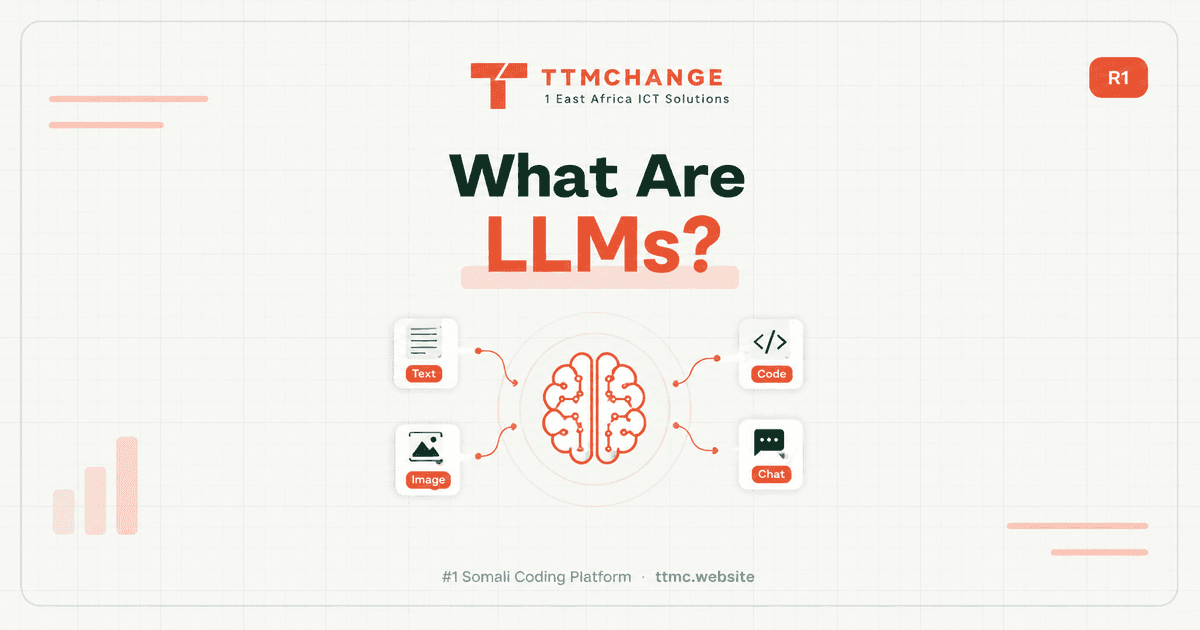
ChatGPT, Claude, Gemini, Llama, and most modern AI systems are built around Large Language Models (LLMs).
But what actually makes a language model "large"? How does it learn language and programming concepts? How does it generate an answer from a simple prompt? And why can the same model sometimes produce different answers to the same question?
Understanding these mechanics matters if you want to move past simply using AI and start building AI-powered software.
What Is an LLM?
A Large Language Model is a machine learning model trained on large-scale datasets to process and generate human language.
At a high level, an LLM learns statistical patterns in sequences of tokens. During training, it processes enormous amounts of text and learns relationships between words, concepts, structures, and other patterns.
For developers, an LLM works as a powerful interface for working with natural language and code. Through an API, an application can ask a model to:
- Generate text
- Explain concepts
- Analyze documents
- Write or review code
- Extract structured information
- Summarize content
- Translate languages
- Classify data
- Reason through complex problems
An LLM is not a database containing copies of everything it has read. It learns parameters that represent patterns from its training process. When you give it a prompt, the model uses those learned parameters together with the current context to calculate which tokens are likely to come next.
Why Are They Called "Large"?
The word "large" refers to several dimensions at once.
1. Training Data Scale
Modern LLMs train on extremely large and diverse datasets combining books, websites, technical documentation, publicly available text, code, educational material, and other licensed or human-generated datasets.
The exact datasets behind commercial models are often proprietary, so claims about a model being trained on "the entire internet" shouldn't be taken literally. What matters is the scale and diversity of the data, not a specific source claim.
2. Model Parameters
Parameters are learned numerical values inside a neural network — part of the model's learned representation of patterns.
Model sizes are often described with terms like:
7B  → 7 billion parameters
70B → 70 billion parameters
More parameters can add capacity, but bigger doesn't automatically mean better. Architecture, training data, optimization techniques, inference methods, and post-training all shape final performance. Exact parameter counts for some frontier models also aren't publicly disclosed, so treat public estimates as estimates, not specifications.
3. Computational Scale
Training a modern LLM can require thousands of accelerators, distributed computing, high-speed networking, large storage systems, data pipelines, and substantial engineering infrastructure.
This is a big part of why training frontier models is mostly done by organizations with significant computational and financial resources.
Pre-Training and Post-Training
Training a modern LLM is more involved than handing it a pile of documents.
Pre-training → Post-training → Evaluation → Deployment → Continuous improvement
Pre-Training
During pre-training, the model learns general patterns from massive datasets. A common training objective is next-token prediction.
For example, given:
"The developer deployed the application to the ___"
The model learns to assign probabilities to possible next tokens based on surrounding context. Repeating this across enormous amounts of data lets the network build increasingly sophisticated internal representations of language and other patterns.
Pre-training is where the model acquires most of its broad capabilities.
Post-Training
After pre-training, models typically go through additional training and alignment steps to make them more useful for real users, such as:
- Supervised fine-tuning
- Preference optimization
- Reinforcement learning techniques
- Instruction tuning
- Safety training
- Domain-specific adaptation
Exact techniques vary between providers. This stage is what turns a general pretrained model into a system that follows instructions, holds a conversation, writes code, and handles specific tasks reliably.
How Does an LLM Generate an Answer?
The core mechanism here is token prediction.
Given the input "React is a JavaScript", the model doesn't search a database for the missing word. It processes the input and calculates probabilities for possible next tokens — illustratively, something like:
library    → 0.72
framework  → 0.15
language   → 0.06
The model selects or samples a next token from that distribution. That token then becomes part of the context, and the process repeats:
Input
  ↓
Tokenization
  ↓
Neural network
  ↓
Next-token probabilities
  ↓
Next token
  ↓
Updated context
  ↓
Repeat
This continues until the model hits a stopping condition or the generation limit. This whole process is called inference.
What Are Tokens?
LLMs generally don't process text the way humans read it. Text is first converted into tokens, which might represent a complete word, part of a word, punctuation, whitespace, or a sequence of characters.
This matters practically: API pricing, context limits, and model input/output capacity are usually measured in tokens, not characters or words.
Why Can the Same Prompt Produce Different Answers?
An LLM doesn't necessarily produce one fixed response for every prompt. Generation involves probability distributions and decoding strategies.
Parameters such as temperature influence how deterministic or varied generation is — with more randomness, the model may select different high-probability tokens across separate runs.
For production systems where consistency matters, developers can use appropriate decoding settings and structured outputs depending on the model and API.
LLMs Don't "Know" Everything
A common misconception is treating an LLM as an infallible source of information.
LLMs generate outputs based on learned patterns and the context available at inference time. They can:
- Produce incorrect information
- Misinterpret a question
- Generate plausible but false statements
- Make reasoning mistakes
- Have outdated knowledge
- Fail when information is missing from context
This is why production AI systems often lean on Retrieval-Augmented Generation (RAG), tool calling, web search, databases, and external APIs — instead of relying entirely on the model's internal knowledge, the application supplies relevant external information at inference time.
Open-Weight vs. Closed Models
LLMs also differ in how they're distributed.
Closed Models
Typically hosted by the provider, accessed through an API or application, with weights kept private and infrastructure managed by the provider. Convenient because developers don't need to run large GPU infrastructure themselves.
Open-Weight Models
Models such as various Llama and DeepSeek releases provide downloadable weights under their respective licenses, letting developers run models locally, deploy on their own infrastructure, experiment with inference, fine-tune supported models, and build specialized systems.
Open-weight doesn't necessarily mean fully open source. Weights, training code, training data, and licensing terms can differ significantly between projects.
Local vs. API-Based LLMs
Both approaches matter if you're learning AI engineering.
API-Based:
Your Application → API → LLM Provider → Response
Advantages: simple deployment, no GPU infrastructure, access to powerful models, easy scaling.
Local Inference:
Your Application → Local Runtime → Local Model → Your Hardware
Advantages: greater control, potentially better privacy, offline inference, local experimentation, predictable infrastructure costs. The trade-off is that you become responsible for hardware, model serving, optimization, monitoring, and maintenance.
Can LLMs Understand Somali?
Yes — many modern multilingual LLMs can process Somali to varying degrees. Language quality depends heavily on the model, training data, tokenizer, evaluation methods, and the specific task.
That gap is also an opportunity: improving Somali-language AI through high-quality datasets, evaluation benchmarks, retrieval systems, fine-tuning, and language-specific tooling. The goal isn't just to make a model "speak Somali" — a strong Somali AI system should be evaluated for accuracy, grammar, cultural context, terminology, translation quality, reasoning, factuality, and safety.
Frequently Asked Questions
Are LLMs just databases?
No. An LLM doesn't retrieve a stored paragraph every time you ask a question — it uses learned parameters to model patterns from its training data and generates output based on the current context. External retrieval systems can be added when an application needs access to specific documents or up-to-date information.
Do LLMs actually think?
Depends on what "think" means. LLMs can perform sophisticated reasoning and problem-solving, especially newer reasoning-oriented models, but that shouldn't be equated with human consciousness or thought. At the engineering level, it's more useful to understand how the model computes its outputs than to anthropomorphize it.
Why do LLMs sometimes hallucinate?
Because generating a likely sequence of tokens isn't the same as guaranteeing factual truth. A model can produce an answer that sounds convincing while being wrong — which is why reliable AI applications combine LLMs with retrieval, tools, validation, structured outputs, and human oversight.
Do bigger models always perform better?
No. Larger models can have more capacity, but performance depends on far more than parameter count. A smaller, well-trained, efficiently optimized model can outperform a larger one on particular tasks.
Conclusion
LLMs aren't magic systems that simply "know everything." They're large neural networks trained on enormous datasets to learn patterns and generate sequences of tokens.
Data → Tokenization → Pre-training → Post-training → Inference → Output
Understanding this pipeline changes how you think about AI. Instead of treating ChatGPT, Claude, or other models as mysterious chatbots, you start seeing them as components that can be integrated into larger software systems.
The real opportunity isn't learning how to prompt an LLM. It's learning how to engineer reliable systems around models — using APIs, RAG, vector databases, agents, evaluation, observability, security, and production infrastructure.