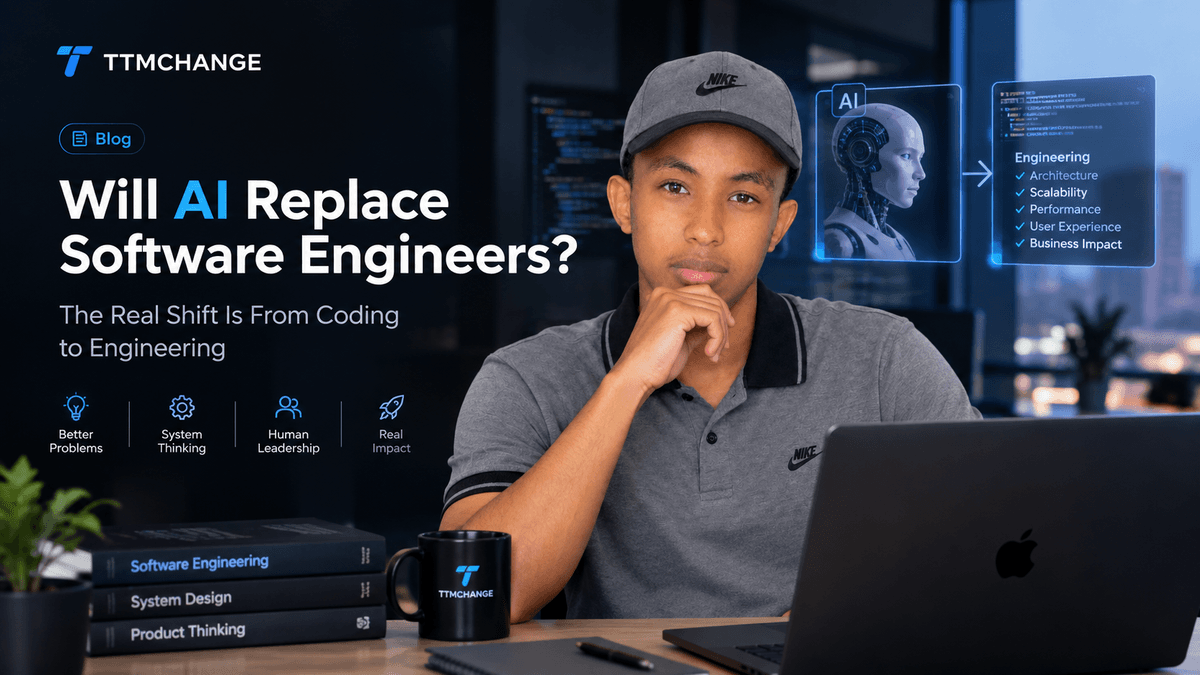
Will AI Replace Software Engineers? The Real Shift Is From Coding to Engineering
AI can write code.
That fact is no longer interesting by itself.
Modern AI systems can generate functions, build interfaces, explain unfamiliar codebases, write tests, find bugs, refactor components, and help engineers move from an idea to a working prototype dramatically faster.
So the obvious question is:
If AI can do more of the work, what happens to software engineers?
The answer is more complicated than "AI will replace developers" or "AI will never replace developers."
The role is changing.
The valuable part of software engineering is moving away from simply producing code and toward understanding systems, making technical decisions, validating AI-generated work, managing risk, and taking responsibility for what reaches production.
That distinction matters.
Because generating code is only one step in building software.
Software Engineering Is Larger Than Coding
A software engineer does not simply translate requirements into source code.
A real production system requires decisions about:
- Architecture
- Data models
- APIs
- Authentication
- Authorization
- Security
- Performance
- Reliability
- Observability
- Deployment
- Cost
- Maintainability
- Failure handling
- Product requirements
- Technical trade-offs
Consider a simple requirement:
"Build a system where teachers can manage student attendance."
Writing the CRUD operations might be straightforward.
But an engineer still needs to answer:
- Who can create teachers?
- Who can modify attendance?
- Can teachers edit historical records?
- What happens when two users modify the same record?
- How are permissions enforced?
- What happens if the database is unavailable?
- How are sensitive records protected?
- How are changes audited?
- What happens when the system grows from 100 users to 100,000?
AI can help answer these questions.
But generating an answer is different from owning the decision.
That is one of the most important distinctions in the AI era.
AI Is Excellent at Implementation Patterns
AI is particularly effective when the problem already has a recognizable implementation pattern.
For example, an engineer might ask an AI system to generate:
export async function getUserById(id: string) {
  return db.user.findUnique({
    where: { id },
  });
}
That is useful.
But the difficult engineering question may not be how to write the function.
It may be:
Should this endpoint expose this user at all?
The code can be syntactically correct while the design is fundamentally wrong.
AI is very good at producing plausible implementations from existing patterns.
This makes it extremely valuable for:
- Boilerplate
- CRUD operations
- API handlers
- Unit tests
- Type definitions
- Documentation
- Refactoring
- Data transformations
- UI components
- SQL queries
- Configuration
- Debugging assistance
The engineer's responsibility increasingly moves toward deciding what should be built and how the pieces should interact.
The Verification Problem
There is a hidden problem with AI-generated code.
The faster code becomes to produce, the more important verification becomes.
Imagine an engineer previously wrote 500 lines of application code manually.
With AI assistance, the same engineer might generate 2,000 lines.
That sounds like increased productivity.
But if the engineer cannot properly review those 2,000 lines, the additional output can become additional risk.
The bottleneck moves.
Before AI

Requirements
     ↓
Design
     ↓
Implementation
     ↓
Testing
     ↓
Deployment


With AI

Requirements
     ↓
Design
     ↓
AI-assisted Implementation
     ↓
Verification
     ↓
Testing
     ↓
Security Review
     ↓
Deployment
The implementation step becomes faster.
Verification becomes more important.
An AI system can generate something that looks reasonable in seconds.
Understanding whether it is actually correct may take much longer.
AI Can Accelerate the Wrong Decision
This is one of the biggest risks of AI-assisted development.
AI increases execution speed.
It does not automatically improve the quality of the original decision.
Suppose an engineer chooses the wrong architecture.
Without AI:
Wrong architecture
       ↓
Slow implementation
       ↓
Problems discovered
       ↓
Rework
With AI:
Wrong architecture
       ↓
AI generates implementation quickly
       ↓
Large amount of code
       ↓
Problems discovered later
       ↓
More expensive rework
AI can therefore make bad decisions more expensive by allowing teams to build them faster.
This is why senior engineering judgment becomes more valuable.
The question is not:
"Can AI build this?"
The better question is:
"Should we build it this way?"
Architecture Still Matters
Software systems are collections of interacting components.
Changing one component can affect many others.
Consider a typical web application:
User
  ↓
Frontend
  ↓
API
  ↓
Authentication
  ↓
Business Logic
  ↓
Database
  ↓
External Services
An AI coding system can help implement almost every layer.
But someone still needs to understand the relationships between those layers.
For example, adding authentication is not simply adding a login page.
Authentication answers:
Who is this user?
Authorization answers:
What is this user allowed to do?
Those are different security problems.
A system that authenticates users correctly but authorizes them incorrectly can still be insecure.
The architecture determines where those decisions are enforced.
That is engineering.
The Difference Between "Works" and "Is Correct"
AI-generated code can often reach a state where something appears to work.
That does not mean the system is correct.
Imagine an API that returns:
{
  "user": {
    "id": "123",
    "name": "Abdalla"
  }
}
The endpoint works.
The request succeeds.
The response looks correct.
But what if the endpoint is accessible to every authenticated user when it should only be accessible to administrators?
The implementation works.
The system is wrong.
This distinction appears everywhere in production engineering.
A payment system can successfully process transactions while handling edge cases incorrectly.
A caching system can improve performance while returning stale data at the wrong time.
A database query can return the expected rows while becoming extremely slow at scale.
A deployment can succeed while silently breaking another service.
Correctness includes behavior under real conditions, not just successful execution in the happy path.
AI Makes Security More Important
More generated code means more code that needs to be reviewed.
Security cannot be delegated simply because an AI system produced the implementation.
Consider an API:
export async function DELETE(request: Request) {
  const id = new URL(request.url).searchParams.get("id");

  await db.user.delete({
    where: { id: id! },
  });

  return Response.json({ success: true });
}
The code may compile.
The database operation may work.
But where is authorization?
A safer design needs to establish who is making the request and whether that user is allowed to delete the requested record.
For example:
const user = await getCurrentUser();

if (!user || user.role !== "ADMIN") {
  throw new Error("Forbidden");
}

await db.user.delete({
  where: { id },
});
Even this simplified example is not a complete security system.
Production applications may also need:
- Input validation
- Rate limiting
- Audit logging
- CSRF protection where applicable
- Secure session handling
- Database constraints
- Error handling
- Monitoring
- Security headers
- Principle of least privilege
AI can help implement these controls.
But security is a system property, not a code-generation feature.
The Junior Engineer Problem
There is another difficult question.
If AI handles more implementation work, how do junior engineers develop engineering judgment?
Traditionally, developers learned by doing relatively small tasks:
Small task
   ↓
Implementation
   ↓
Bug
   ↓
Debugging
   ↓
Understanding
   ↓
Better implementation
AI can remove some of the friction from that learning process.
A developer can ask:
"Fix this."
And receive an answer immediately.
That is convenient.
But convenience can hide the learning opportunity.
If a developer repeatedly accepts generated solutions without understanding them, they may become dependent on a system they cannot effectively evaluate.
The solution is not to avoid AI.
The solution is to use AI as a learning accelerator rather than a replacement for understanding.
Ask:
- Why did this solution work?
- Why did the original solution fail?
- What assumptions does this implementation make?
- What are the security implications?
- How would this behave at scale?
- What alternatives exist?
That creates engineering knowledge.
Fundamentals Become More Valuable
AI changes the value of knowing syntax.
It does not eliminate the value of understanding fundamentals.
If anything, fundamentals become more important because they determine how effectively you can evaluate generated solutions.
An engineer should understand concepts such as:
- Data structures
- Algorithms
- HTTP
- Networking
- Databases
- Operating systems
- Concurrency
- Authentication
- Authorization
- Distributed systems
- Testing
- Security
- Version control
- System design
You do not need to manually implement everything from scratch.
But you should understand what the system is doing.
For example, if AI generates a database query using multiple joins, the engineer should understand what those joins mean.
If AI proposes caching, the engineer should understand cache invalidation and consistency trade-offs.
If AI suggests a message queue, the engineer should understand asynchronous processing and failure modes.
AI reduces the cost of producing code. It does not reduce the complexity of the systems that code operates inside.
Prompting Is Not the Core Skill
Prompting is useful.
But prompting alone is not a durable engineering advantage.
A person who knows very little about software can ask:
"Build me a scalable authentication system."
An AI model may generate a large amount of code.
The difficult part is determining whether the resulting architecture is appropriate.
An experienced engineer can provide better constraints:
Requirements
    ↓
Constraints
    ↓
Architecture
    ↓
Implementation strategy
    ↓
AI-assisted generation
    ↓
Verification
    ↓
Production
The quality of the output depends heavily on the quality of the engineering context.
This is why problem framing is more important than simply knowing how to phrase prompts.
The engineer needs to understand the problem deeply enough to tell the AI what constraints matter.
The Engineer Becomes the System's Reasoning Layer
A useful way to think about AI-assisted engineering is that AI becomes an implementation multiplier.
The engineer remains responsible for the reasoning layer.
Product Requirements
        ↓
Engineering Judgment
        ↓
System Architecture
        ↓
AI-Assisted Implementation
        ↓
Verification
        ↓
Security & Testing
        ↓
Deployment
        ↓
Monitoring
        ↓
Feedback
        ↺
The AI can participate throughout this pipeline.
But the engineer still needs to maintain the mental model of the system.
That means understanding:
- Why the system exists
- What constraints it has
- Which failures are acceptable
- Which failures are dangerous
- Which data is sensitive
- Which components are critical
- How users interact with the system
- How the system behaves under failure
That is much closer to system ownership than traditional code production.
The Economics of Software Will Change
AI-assisted development can reduce the amount of human effort required for certain implementation tasks.
That can change software economics.
Some tasks that previously required significant developer time may become much cheaper.
For example:
| Work | Before AI assistance | With strong AI assistance |
|---|---|---|
| Boilerplate | Manual | Often generated |
| Basic CRUD | Manual | Often accelerated |
| Documentation | Manual | Strongly accelerated |
| Test generation | Manual | Strongly accelerated |
| Refactoring | Manual | Often accelerated |
| Architecture decisions | Human-led | Human-led with AI assistance |
| Security ownership | Human responsibility | Human responsibility |
| Product decisions | Human responsibility | Human responsibility |
| Production ownership | Human responsibility | Human responsibility |
This does not mean every software job disappears.
It means the amount of output expected from an engineer may increase.
A small team may be able to build systems that previously required a much larger engineering team.
That creates a new expectation:
Engineers may be judged less by how much code they personally type and more by how much valuable, reliable software they can deliver.
The Real Bottleneck May Be Engineering Judgment
Imagine an AI system capable of generating ten possible architectures.
The problem is no longer:
"Can we create an architecture?"
The problem becomes:
"Which architecture should we choose?"
That requires trade-offs.
Suppose you are choosing between:
- A simple monolithic application
- A modular monolith
- Several microservices
- Serverless components
- Event-driven architecture
There is no universal answer.
The right choice depends on:
- Team size
- Product requirements
- Operational complexity
- Traffic
- Reliability requirements
- Data consistency
- Budget
- Deployment model
- Expected growth
- Organizational constraints
AI can explain the trade-offs.
It can even recommend an option.
But someone needs to decide whether the recommendation fits the actual system.
Engineering is not the ability to produce many possible answers. It is the ability to choose the right answer under constraints.
What Engineers Should Learn Now
The answer is not to compete with AI at typing code faster.
Learn the things that make AI more useful to you.
1. Learn Programming Fundamentals
Understand how programs actually work.
Learn:
- Variables and data types
- Functions
- Control flow
- Data structures
- Algorithms
- Error handling
- Asynchronous programming
- Memory and performance concepts
The goal is not memorization.
The goal is understanding.
2. Learn How Systems Actually Work
Go beyond frameworks.
Understand:
- HTTP requests
- DNS
- TCP/IP basics
- TLS
- Databases
- Caching
- Processes
- Threads
- Containers
- Cloud infrastructure
When something breaks, you should have enough knowledge to reason about where the failure might be.
3. Learn System Design
Start thinking in systems rather than files.
Ask:
Who calls this service?
        ↓
What data does it need?
        ↓
Where is the data stored?
        ↓
Who is allowed to access it?
        ↓
What happens when the dependency fails?
        ↓
How does the system recover?
This mindset becomes increasingly valuable as AI handles more implementation.
4. Use AI for More Than Code Generation
Use AI as an engineering partner.
Ask it to:
- Review architecture
- Identify edge cases
- Generate test cases
- Explain unfamiliar code
- Challenge your assumptions
- Find security risks
- Compare implementation strategies
- Review database schemas
- Simulate failure scenarios
For example:
"Here is my authentication architecture. Find the security assumptions that could fail in production."
That can be more valuable than:
"Write my authentication system."
5. Verify High-Impact Code
Not every generated line deserves the same level of scrutiny.
Pay particular attention to:
- Authentication
- Authorization
- Payments
- Data deletion
- Database migrations
- File access
- Cryptography
- Secrets
- Infrastructure
- User-generated content
- External API integrations
The higher the impact of a failure, the more carefully the implementation should be verified.
The Skills That Will Matter More
The value of different engineering skills is likely to change.
| Skill | Direction |
|---|---|
| Writing repetitive boilerplate | Less valuable |
| Memorizing syntax | Less valuable |
| Basic code generation | Less valuable |
| Debugging | More valuable |
| System design | More valuable |
| Security engineering | More valuable |
| Architecture | More valuable |
| Requirements analysis | More valuable |
| Technical communication | More valuable |
| Code review | More valuable |
| Production operations | More valuable |
| Engineering judgment | More valuable |
This does not mean coding becomes irrelevant.
It means coding becomes one part of a larger engineering capability.
Will AI Replace Some Software Jobs?
Yes, some software-related work will probably require fewer people as automation improves.
That is different from saying:
"Software engineering will disappear."
The more realistic outcome is that some tasks will be automated, some roles will change, and expectations for engineers will increase.
A developer whose primary value is manually producing repetitive code is more exposed to automation than an engineer who can:
- Understand complex systems
- Make architecture decisions
- Debug difficult failures
- Protect systems
- Communicate requirements
- Evaluate trade-offs
- Lead technical decisions
- Operate production systems
The boundary is not simply "AI versus humans."
The boundary is increasingly between low-context execution and high-context engineering judgment.
The Real Shift: From Code Producers to System Owners
The most important change is not that AI can generate code.
It is that AI is making implementation cheaper.
When implementation becomes cheaper, other parts of engineering become relatively more important.
The workflow starts to look like this:
Old Model

Idea
 ↓
Human writes code
 ↓
Human tests code
 ↓
Human deploys code


AI-Native Model

Idea
 ↓
Requirements
 ↓
Architecture
 ↓
AI-assisted implementation
 ↓
Automated testing
 ↓
Human verification
 ↓
Security review
 ↓
Deployment
 ↓
Observability
 ↓
Continuous improvement
The engineer becomes responsible for the entire loop.
That is a bigger role, not necessarily a smaller one.
The Bigger Picture
Software has always been an abstraction game.
We moved from machine code to assembly.
From assembly to higher-level languages.
From manual memory management to managed runtimes.
From servers managed manually to cloud infrastructure.
From manually written interfaces to component systems.
Each abstraction reduced the amount of low-level work engineers needed to perform.
AI is another layer of abstraction.
The important question is not whether engineers will continue typing every line manually.
They probably will not.
The important question is whether engineers will continue to understand the systems they create.
They must.
Because abstraction does not remove complexity.
It moves complexity to a different layer.
AI can hide implementation details.
It cannot remove the consequences of a bad architecture.
Conclusion
AI will change software engineering.
It will automate some implementation work, accelerate development, and allow engineers to produce significantly more with the same amount of time.
But software engineering is not simply code generation.
The difficult parts remain:
- Understanding the problem
- Designing the system
- Choosing trade-offs
- Verifying behavior
- Securing data
- Handling failures
- Operating production systems
- Taking responsibility for outcomes
The engineer of the future will probably write less code manually.
But that does not mean the engineer becomes less important.
It means the engineer must understand more.
When code becomes cheaper to produce, engineering judgment becomes more valuable.
The future of software engineering is not humans versus AI.
It is engineers who understand systems using AI to build them with greater leverage.
The advantage will not belong to the engineer who refuses AI.
It will not belong to the engineer who blindly trusts it either.
It will belong to the engineer who can design deeply, use AI effectively, verify rigorously, and take ownership of the system from architecture to production.