What Is Load Balancing?
A single server can only handle so many requests before it slows down, times out, or crashes — while other servers in your infrastructure sit idle doing nothing.
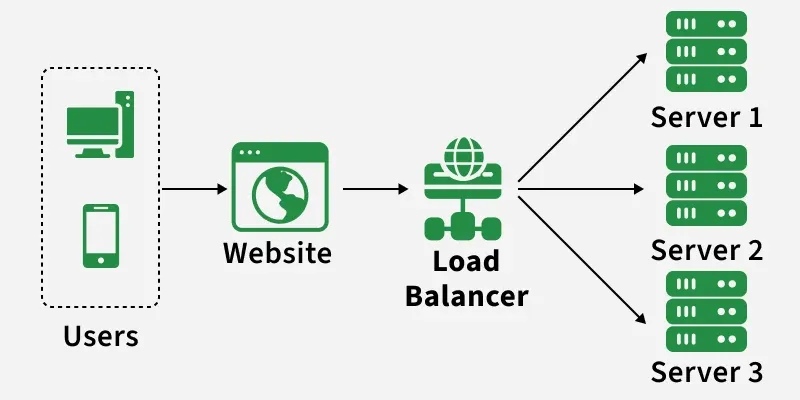
Load balancing is the technique that fixes this: distributing incoming network traffic and application requests across multiple servers so no single one becomes a bottleneck.
In simple terms, load balancing is what keeps applications fast, reliable, and highly available as traffic increases.
What Is a Load Balancer?
A load balancer sits between clients and backend servers and decides where each incoming request should go.
Without one, a spike in traffic could pile every request onto one server while the rest stay underused.
A Simple Analogy
Think of a load balancer like a traffic controller. When thousands of cars (users) arrive, the controller directs them across different roads (servers) to prevent congestion.
Or picture a supermarket with five checkout counters. Instead of sending every customer to the same cashier, a manager directs people toward available counters so the whole checkout system keeps moving.
That's essentially what a load balancer does for servers.
How Does Load Balancing Work?
Load balancers use different algorithms to decide which server should handle each request. Three common approaches:
Round Robin
Requests are distributed sequentially across available servers.
Request 1 → Server A
Request 2 → Server B
Request 3 → Server C
Request 4 → Server A
It's simple and works well when servers have similar capacity and workloads.
Least Connections
The load balancer sends the new request to whichever server is currently handling the fewest active connections.
This is useful when requests have significantly different processing times, so raw round-robin distribution would leave some servers overloaded and others idle.
IP Hash
The load balancer uses the client's IP address to consistently route that client to the same server.
This can help with session persistence, though modern architectures often prefer external session storage instead, so users aren't tied to a single server.
Layer 4 vs. Layer 7 Load Balancing
Load balancing can also be categorized by which layer of the network stack it operates at.
Layer 4 — Transport Layer
Layer 4 load balancing makes routing decisions using:
- IP addresses
- TCP/UDP ports
- Connection information
Because it doesn't inspect application-level content, it's fast and efficient — but it has no visibility into higher-level HTTP details.
Layer 7 — Application Layer
Layer 7 load balancing operates at the application level and can inspect:
- URLs
- HTTP headers
- Cookies
- HTTP methods
For example, it could route:
/images/* → Image servers
/videos/* → Video servers
This makes Layer 7 load balancing more flexible for modern web applications, since routing can depend on what's actually being requested, not just where it's coming from.
Popular Load Balancing Tools
Some widely used load-balancing technologies:
- Nginx
- HAProxy
- AWS Elastic Load Balancing
- Cloudflare load-balancing services
- Cloud-native load balancers from major cloud platforms
The right choice depends on your architecture, traffic patterns, infrastructure, and operational requirements.
Why Load Balancing Matters
Load balancing is a fundamental part of building scalable and highly available systems.
Large-scale platforms rely on distributed infrastructure to handle enormous traffic volumes. Instead of depending on a single server, traffic gets distributed across many servers and, in larger architectures, across multiple regions.
That brings several concrete benefits:
- Scalability — add more servers as traffic increases
- High availability — keep serving traffic when individual servers fail
- Better performance — spread workloads across multiple machines
- Fault tolerance — reduce the impact of any single server failure
- Zero-downtime deployments — gradually shift traffic between server instances during updates
Load balancing lets your infrastructure scale without making a single server responsible for everything.
Conclusion
Load balancing isn't an advanced optimization you add once you're at Google's scale — it's one of the earliest infrastructure decisions that determines whether your application survives its first real traffic spike.
As your application grows, load balancing stops being optional and becomes one of the core building blocks of production-grade infrastructure.